US$15 mill Chinese pine tree resin factory to open end of June in Mutasa District
February 3, 2026
No 2026 PSL action at Sakubva Stadium due to renovations: Chafesuka
February 11, 2026No more to water barons says City of Mutare as it debunked its ambitious ZIG 2.5 billion 2026 approved budget
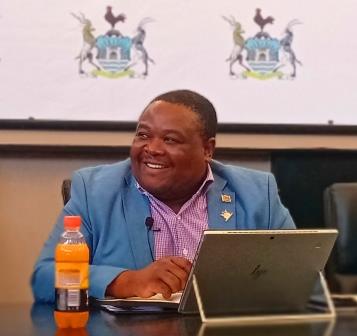
City of Mutare town clerk Blessing Chafesuka
…Major Highlights
- Completion of servicing stands at the long abandoned Beira Corridor project in the pipeline
- Murahwa Market traders to be removed in three (3) weeks time to new site
- Drug and substance abuse rehabilitation centre to be constructed
- Education Special Rate levy to build new schools
Ngoni Dapira
THE City of Mutare says this year it intends on maintaining an average water supply of 22 hours and will set up water kiosks in all dysfunctional communities that have been experiencing water shortages. The local authority said it will also clamp down ‘extortive’ operations by water barons that were making money from that unfortunate systemic gap.
This was revealed on Monday by the City of Mutare town clerk Blessing Chafesuka during a press briefing on the approved 2026 budget.
He said the approved 2026 budget by the Minister of Local Government and Publics Works Honourable Daniel Garwe is ZiG 2,582,442,822, which is currently about US$100,230,266. Chafesuka said they want to increase their coverage of basic water supply to 100% including in dysfunctional communities.
“Last Friday Council resolved that we want to install water kiosks. We had water losses in areas like Federation in Dangamvura. There were water barons that were getting water from our open points and selling the water in areas without water. So we then resolved that even in the Mahalape area we will also put up these kiosks. That project we should be able to deliver it this year. By end of this year we should be saying there is no area without access to clean and safe water. That is our target this year,” said Chafesuka.
In Gimboki and Federation areas in Dangamvura as well as the Mahalape area near the railways line, opportunistic vendors who exploit chronic water shortages by selling water at exorbitant prices, who became known as water barons, have been cashing in for years, sometimes as high as US$3 per 200-litres container. These vendors have been operating in areas lacking municipal supply, capitalizing on the absence of formal infrastructure, often in illegal settlements.
Chafesuka however revealed that the 2026 budget has a disbursement condition of integrating all Information and Communication Technology (ICT) systems by 30 June 2026, otherwise some funds will not be released. He added that the City of Mutare has also complied with the Government’s directive to streamline and reduce licensing requirements as part of the national “ease of doing business” initiative pronounced last year.
“We were instructed to create a new department for ICT, so that department will help us to integrate our ICT system as instructed. Accordingly, the City has aligned its 2026 licence budget to reflect the ease of doing business directives by the Central Government. Most licensing tariffs have been reduced, so we just copied and pasted. Some are lower and some are higher but we are merely complying and implementing as it is,” said the town clerk. He however said nearly 99 percent of the licences have been reduced.
The liquor licences and shop licences were amongst those reduced which were a topical issue year in year out for business operators. The liquor Licence for a bar hotel went down from US$702 to US$20, whilst that of bottle stores and clubs respectively went down from US$395 to US$20 and US$615 to US$20. The shop licences for 1 to 30 sq/m went down from US$386 to US$200 whilst the operating shop licences application fee went down from US$132 to US$20.
The annual operating permits basic charge for first registration annually and the annual operating permits trading app fee for trading licences also went down from US$176 to US$20 and US$132 to US$20 respectively.
However, government increased the annual operating permits for boarding houses and guest houses from US$66 to US$153, the annual operating permits for debt collection from US$263 to US$500, the annual operating permits for driving schools Class 4 from US$176 to US$250 as well as the annual permits for licenced hotels from US$110 to US$1725. The annual operating permits for lodges remained at US$500.
The town clerk highlighted that the Education Levy returns as a Special Rate as duly approved by the Government, based on the 73 percent resident’s approval in pre-budget consultations. In the high density areas the special education levy will be $1, low density area $2, Small to Medium Enterprises (SMEs) $6 and $12 for the commercial, institutional and industrial areas.
Chafesuka said the water, sewer and refuse tariffs will be implemented in accordance with the approved and modeled cost recovery tariff structure. He said the 27 percent rates tariff increment was approved whilst all other tariffs have been approved at 14.2 percent in line with prevailing Reserve Bank of Zimbabwe average USD inflation as of 31 August 2025. This will see the estimated statements for commercial and institutional areas rise from US$729 to US$904, whilst high density areas like Chikanga and Dangamvura will increase from US$30 to US$37. Estimated statements for low density suburbs will increase from US$58 to US$72 whilst industrial areas will range from US$1124 to US$1332.
“The major driver of increasing our water tariffs is the cost of our water chemicals. This is one area that we want to protect as a Council. Water quality and consistent supply of water is our strength as a city and we do not want to compromise on this one. But the key driver was that cost of water chemicals increased and also the fact that ever since the Pungwe line was constructed we were using old stock pipes, but we are now out of stock and we are buying new water pipes, which are a bit costly,” explained Chafesuka on the tariff increments.
On key projects he said this year they want to build a service station in Sakubva as a cost cutting measure and for income generation, build a drug and substance abuse rehabilitation centre in collaboration with their parent Ministry and complete servicing stands at the long abandoned Beira Corridor housing project.
He mentioned that other key targets of the budget will be on fixing non-revenue water, pipe bursts, street lighting and the Sakubva Urban Renewal project. On the US$6million Sakubva Urban Renewal project at Murahwa Greenmarket he said in the next three weeks they will move all traders from Murahwa Market to the new temporary site next to the Quest Motors Manufacturing plant, to pave way for construction works to start at Murahwa Market.
On roads he said they are expecting more resources from the Zimbabwe National Road Authority (ZINARA) because the resources they have been getting are not enough, but they will do their best to make ends meet and improve road conditions and overall trafficability, raising the current level from 57.8 percent to 60 percent.
“So we really hope the residents will support this budget. Without your input we will fail as an authority. I know some people will be angry at the outcome, but we tried to incorporate most opinions raised during pre-budget consultations,” said Chafesuka.