
Super ‘predict and win’ soccer matches weekends come alive at Flavourtown
May 1, 2026
Mutare Mayor Chabuka calls for facelift of cemeteries in the city
May 8, 2026Mutare Mayor Chabuka reads the riot act on council executive

City of Mutare Mayor Simon Chabuka (raising hand) during a tour of the the Council's asphalt plant near the Dangamvura Link Road on Tuesday.
“Whether you take it as an instruction or council resolution I am saying no to pothole filling on tar roads with gravel only without asphalt concrete. The gravel after rains is blocking our drains and water ways. Better we leave them open until we have the asphalt concrete. Am I being unreasonable? Week in week out we see some gravel potholes being redone. That is not viable,” said the Mayor.
Ngoni Dapira
CITY OF MUTARE Mayor Simon Chabuka on Tuesday read the riot act on his council executive to enforce discipline, accountability and efficiency in the local authority.
This was said during a tour of what he called ‘dysfunctional’ and ‘long overdue’ projects in the eastern border city, before addressing the 1336th Full Council meeting.
He said the severe reprimand was meant to demonstrate that as Mutare councilors they mean business. He said the development of the city should be the top priority of council and castigated the lethargic culture creeping among management, which he said needs to be nipped in the bud. He said there is need to up their game and eschew laziness to meet the expectations of ratepayers.
The Mayor, councilors, council executive and the Mutare District Development Coordinator Tendai Kapenzi toured the Flyover bridge along the Mutare-Masvingo road which has been topical over the years in need of expansion to alleviate severe traffic congestion. They also toured the Moffat Hall in Sakubva which is a community hall and landmark for Mutare residents, but the relic has been left in a dilapidated state for years with no renovations. The delegation then visited the Council’s asphalt plant near the Dangamvura Link Road, St Joseph’s Cemetery in Sakubva which has been neglected for years and the newly designated Dangamvura bus terminus at the old Mudzviti bus terminus where there is an outcry from discontent Dangamvura residents.
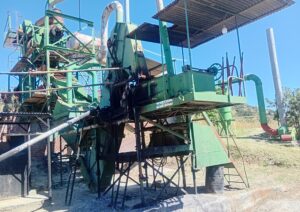
The City of Mutare asphalt plant.
Speaking at the asphalt plant, Mayor Chabuka revealed that the council executive has not been reporting on progress or constraints concerning the plant which is very critical for producing asphalt concrete primarily used for road construction and maintenance. He said the plant is critical in cutting costs of buying asphalt concrete from suppliers at a higher premium and should have been tabled as a top priority a long time ago.
“We have never received a report that such a big plant is not working and the town clerk you would just sit at your office with your management knowing very well that there is a plant not working and not taking appropriate measures to have this plant work. From last year July it’s almost now a year and such a plant is not working and we are forced to fill up our potholed tar roads with gravel only. Town clerk like I said before. In Mutare I do not want to see anymore, a tar road with potholes being patched with gravel only. There must be asphalt concrete (bitumen). This plant must work,” candidly said the Mayor.
The director for engineering and technical services Engineer Maxwell Kerith explained that the plant used to have a bitumen pump that seized in 2016 and could not be replaced because it was an old model. They however managed to modify the operations to make the plant work again.
“We spent around US$30 000 through the ERRP2 (Emergency Road Rehabilitation Programme Phase 2) fund and we also got bitumen from central government. That’s the only time that we really made use of the plant. We bought a diesel boiler from Pungwe Breweries to replace the old one that could not be used safely, but unfortunately the boiler could not be applied to the system because there were components that Pungwe Breweries failed to supply. So we are now thinking of disposing this boiler,” said Eng Kerith.
He added that apart from the boiler problem the asphalt plant is also currently not functional because their power transformer is down after being struck by lightning. He however said the latest development concerning the power transformer was that the Zimbabwe Electricity Transmission and Distribution Company (ZETDC) had promised to replace the transformer by end of this week.
Eng Kerith said at full capacity the plant can produce 10 cubic meters per hour which is about 80 cubic meters in a normal eight hours working day. However in its current state the plant can produce 40 cubic meters a day which is enough to cover 1200 square metres on average.
“Our major challenge is procurement of material. Last year we had a tender of 10milli metre crushed stones and quarry dust but towards the point of delivery end of the year the supplier pulled out. Right now in stock we have 79 grammes of bitumen but we have no stones and quarry dust. We have a new supplier though and hope to start production soon,” said Eng Kerith.
During the Full Council meeting in his report on the state of the roads in Mutare, Eng Kerith said only 16 percent of tarred roads are in good condition with 73 percent of the total network requiring rehabilitation or total repair.
“We have 293 km of tarred road and 46km in good condition. 247km require either rehabilitation or reconstruction. We have 94km of road which requires re-gravelling. We have 120km of earth road which requires rehabilitation or reconstruction. So in total we have 507km total road length with 46 km in good condition with 367km requiring rehabilitation or reconstruction and 94km requiring gravel,” said Eng Kerith.
City of Mutare town clerk Blessing Chafesuka buttressed that the city has a roads crisis mostly because funds from the Zimbabwe National Road Administration (ZINARA) are coming late. He revealed that at the moment they owe ZiG 4 million to contractors which was supposed to come from treasury last year but has not been disbursed up-to-date.
“We are owed ZiG 4 million for work done by the council last year which was supposed to be funded by treasury last year. What we are doing now from our own collections every month, we make payments to the contractors, but this is money that was supposed to come from treasury and it is straining us, because this money we are paying with is money which is supposed to go towards our routine maintenance. It is not looking good. Our roads are grossly underfunded. Treasury promised disbursements after independence this year (last month) but we are aware of its financial constraints, so we have to make do with what we have for now,” said Chafesuka.
However, on the issue of pothole filling with gravel only on tarmac roads, Mayor Chabuka maintained a firm position even after the report on the state of the roads by Eng Kerith.
“Whether you take it as an instruction or council resolution I am saying no to pothole filling on tar roads with gravel only without asphalt concrete. The gravel after rains is blocking our drains and water ways. Better we leave them open until we have the asphalt concrete. Am I being unreasonable? Week in week out we see some gravel potholes being redone. That is not viable,” said the Mayor.
On the 9km Magamba Road, the Mayor said in the absence of funds to tar the road it must be frequently graded because it is a busy road that connects many suburbs. Magamba Road which stretches from the Fairbridge Park turn off along the Mutare- Harare highway to Chikanga, connecting with other high density suburbs surrounding Hobhouse is a busy road used by public transporters.
Proportional representation councilor Charity Chirara concurred with the Mayor and added that the quality of workmanship on the new roads needs to be evaluated. She cited the road markings that quickly fade and gravel that is left dumped along the roads after completion of works.
In his resolve, Mayor Chabuka said the chairman of the public works committee, the city engineer and the town clerk should do a tour and report on the status of the newly refurbished roads to assess the quality of workmanship by contractors before engaging them.