


Historic Pride of Mutare International Boxing Tournament on the cards
May 13, 2026
State-of-the-art shopping mall, Quest Shopping Center, expected to open its doors in July
May 15, 2026Quest Motor Manufacturing (QMM) new ventures repositioning Zim’s vehicle manufacturing industry
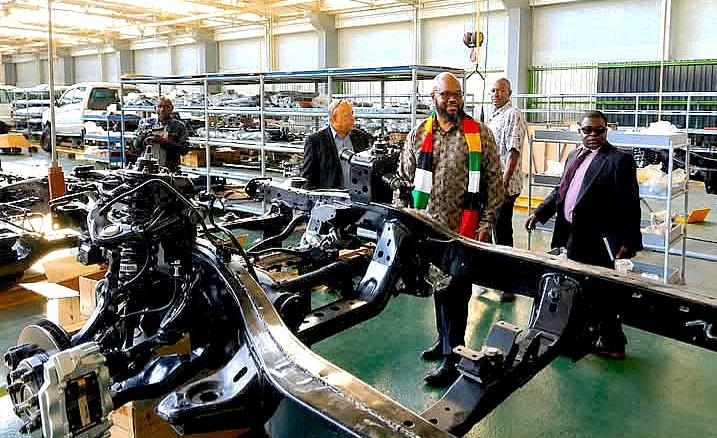
The Minister of State for Manicaland Provincial Affairs and Devolution Honourable Advocate Misheck Mugadza (with scarf) touring the new production line at Quest Motor Manufacturing (QMM) in Mutare on Monday.
…Minister Mugadza pledges Government support
Ngoni Dapira
MUTARE’s vehicle assembling plant Quest Motor Manufacturing (QMM) is on the verge of a major comeback to revive production at its once moribund factory through its new strategic partnerships and green revolution concept, Easterntimeszim has learnt.
Through its new production line of modern, strong and established diesel range vehicles and introduction of locally assembled electric vehicles, Zimbabwe will not only be reclaiming its position in vehicle manufacturing, but positioning itself ahead of the curve in the region’s evolving energy transition. QMM has also partnered with Selected Motors, which is the automotive retail and distribution arm of the Selected Group — a diversified regional industrial business with operations across Zimbabwe, Zambia, Mozambique and Namibia.
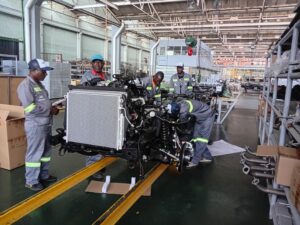
Men at work in the QMM factory assembling a JAC T9 vehicle,
There is an old saying on overcoming adversity that says, “You may encounter many defeats, but you must not be defeated.” That saying speaks volumes about QMM, the country’s first assembling plant that has been operational since 1960. 15 years ago the plant nearly shut down but managed to stay afloat operating below five (5) percent capacity utilization at some point in 2012. That deadlock led to massive retrenchments. Back then, if one dropped a coin on the floor in the factory it would be literally heard clearly because there was virtually little to no production at the once industrious assembling plant.
However, the company was amongst the first to adopt Government’s ‘Look East’ policy in 2011 and cemented partnerships of assembling Chinese make vehicles as completely knocked down (CKD) kits. In 2014, as Quest Motors then, it started manufacturing JMC, Foton and Chery vehicles as well as Zhongtong buses and Foton tractors. The venture improved its capacity utilization a bit but they faced challenges of competition from the influx of second hand vehicles and the import syndrome of new vehicles by both government and the private sector.
Late last year Quest Motors rebranded to QMM and further strengthened its Chinese make partnerships with Foton and JAC, adding the Yutong franchise. In November last year QMM just after rebranding launched its first line of vehicles assembled at the plant, the JAC T9 double cab, then in February this year launched the Foton Tunland V9, the latest edition, with production of the JAC T8 and JAC T6 following next month. They are currently assembling 28 seater Yutong D7 minibuses and will soon be assembling 48 seater Yutong F9 buses.
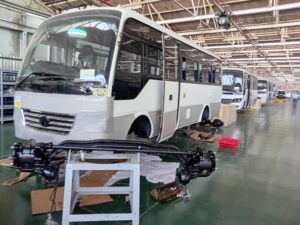
A 28 seater Yutong D7 minibus near completion in the factory.
Now the company celebrates another milestone in its perseverance as it is set to start assembling new energy vehicles, starting off with electric vehicles, the BAW Mini car, Skyworth SUV and GAC Aion V, all scheduled for assembly by August this year. It will also do electric transport solutions assembling 1.9 ton, 3 ton and 5 ton trucks, followed by low cost electric tricycles ranging from 300kg, 500kg, 1000kg and 5000kg.
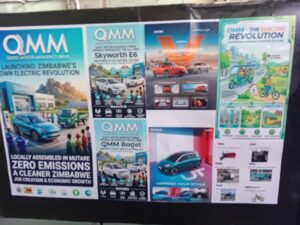
The QMM green revolution illustration banner in the showroom.
QMM general manager on Monday during a tour at the plant by the Minister of State for Manicaland Provincial Affairs and Devolution Honourable Advocate Misheck Mugadza said they are excited about the new projects at the plant which have seen them invest USD$10 million towards semi knocked down (SKD) kits for its new production line.
“To date we have deployed US$1.2 million into factory upgrades. By August 2026 we will receive US$300 000 worth of specialized equipment, including new body shop welding guns, a high efficiency standalone paint shop line and a 5 station rolling road test centre to ensure international quality compliance. We are also turning the factory into a solar powered plant. These upgrades will allow QMM to achieve a production capacity of 5000 vehicles per month in SKD form. From July we are targeting production of a 100 units per month. Our ultimate vision is to return to CKD assembly, maximizing technology transfer and skills development,” said Fernandes.
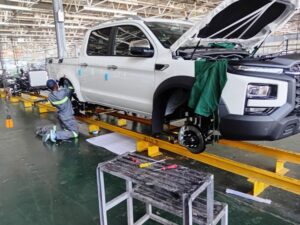
A JAC T9 near completion in the factory.
He said to support their new energy vehicles assembly venture they will also roll out solar powered fast charging networks and stations countrywide, though their electric vehicles can also be home charged.
“Our goal is clear, to pioneer the assembly of new energy vehicles right here in Zimbabwe. However, to sustain this investment, we respectfully urge the government to enforce local procurement laws, ensuring that government departments and parastatals prioritize locally assembled units over imported vehicles,” implored the QMM general manager.
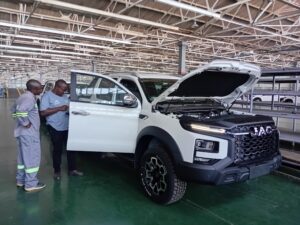
A recently assembled JAC T9 car being tested.
Selected Motors chief executive officer Justin de Ricquebourg said his company has operated in the Southern African region since 2005 and Zimbabwe sits firmly at the centre of its long-term growth strategy.
“Selected Motors is proud to be the official retail partner of Quest — the pioneering local vehicle assembly operation, helping place Zimbabwe back onto the automotive manufacturing map. Quest assembles the vehicles. We bring them to market. Together, we create a fully localised value chain — from assembly line to customer driveway. This partnership is intentional. It is designed to retain value within the country through local assembly, local distribution, local employment and local skills development. We are proud of what this partnership represents — a return to industrial capability, a belief in local value creation, and confidence in the future of this country,” said Justin de Ricquebourg.
Adding, “Through this partnership, Selected Motors is expanding its national footprint — growing our dealer network and creating skilled employment opportunities across sales, after sales, technical support, servicing, logistics, and customer care. Every vehicle sold through this ecosystem supports jobs, develops skills, and contributes directly to Zimbabwean families and communities. We are not simply selling vehicles — we are helping build livelihoods and industrial capability.”
He said the vehicles assembled by Quest and distributed through Selected Motors are being positioned for the broader SADC region — including Zambia, Mozambique, Namibia and beyond.
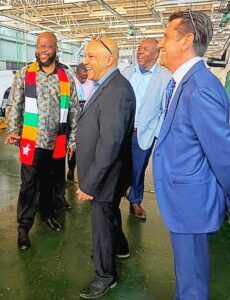
L-R: Hon Adv Minister Misheck Mugadza, Carl Fernandes and Tarik Adam during the factory tour.
QMM director Tarik Adam said everything they are doing is anchored on vision 2030 by President Emmerson Mnangagwa and the National Development Strategy 2 (NDS2). He said it has been tough but he is happy they have managed to keep the factory open through some very turbulent times and now they have managed to modernize it. “This milestone places Zimbabwe at the forefront of the green energy revolution in the region. It speaks directly to the Second Republic’s commitment to industrialization, import substitution and building a future-ready economy, and that is what every Zimbabwean should be proud of,” said Adam.
Adding, “The economic impact of this expansion is profound. We project 300% to 500% increase in employment. By moving to a contract assembly model, we are empowering retail partners like Apex Auto, fostering a new generation of young entrepreneurs, whilst Selected Motors has a network of dealers in the region and is ready to export locally assembled units from Mutare through its subsidiaries.”
He said from less than 100 employees during its struggling days they currently scaled up to 600, but including the dealership ventures they can reach up to 1000 people gainfully employed.
Minister Mugadza said the forward looking investment will broaden the footprint of industrial revitalization in Manicaland. He added that under the Second Republic through sound blueprints like NDS1 and now NDS2, the economy is experiencing massive investment in the manufacturing sector with modern industrial investment, as well as in other sectors like mining and tourism.
“What we intend to do is to make sure all Government departments, councils, schools and transport operators prioritise buying locally assembled vehicles. This project accelerates our national economic development agenda and creates job creation,” said Min Mugadza.
He added that Government inline with Presdent Mnangagwa’s vision 2030 will beyond doubt support the new venture to prove that Zimbabwe is a safe destination for investments, citing that already statutory instruments are being implemented to reduce the cost of business and improve on the ease of doing business.
Representatives from Yutong and Foton also attended the tour.

Related posts
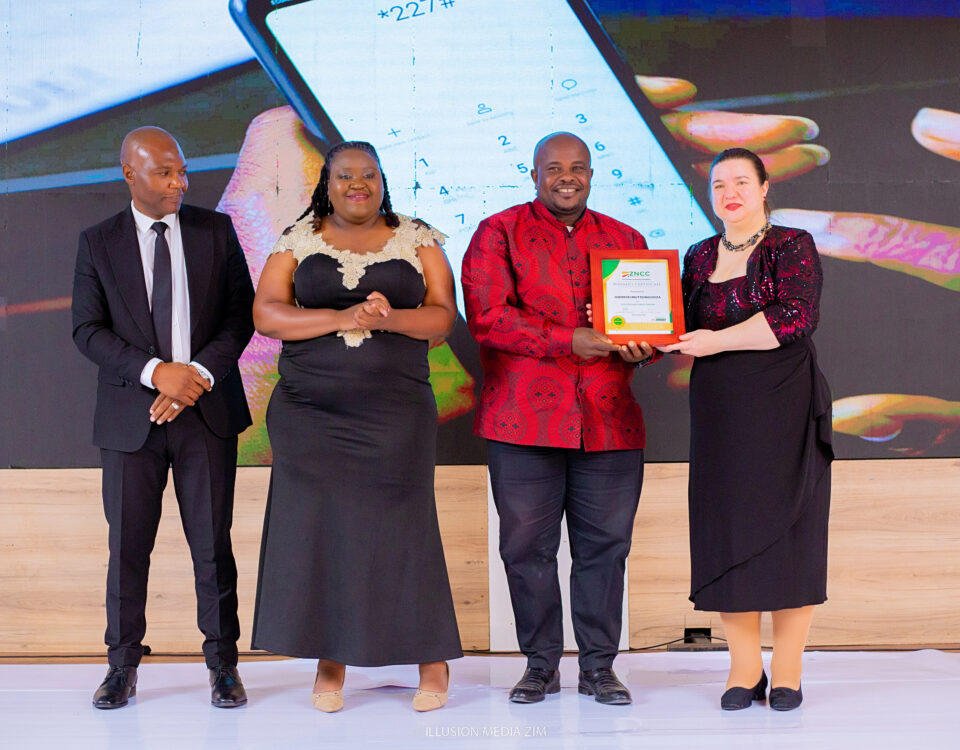
Mutare's renowned educationist cum businessman Stephen Gwinyai Mutsongodza (holding award) made history by becoming the second businessman from Manicaland after the late Hlanganiso Matangaidze to scoop the ZNCC national Businessman of the Year award at the national awards ceremony recently held in Victoria Falls.