Mutsongodza makes clarion call to Manicaland business community to unite and donate to Victoria Chitepo Hospital to help save lives
July 8, 2026
Zimbabwe applauded for spearheading climate smart agriculture in the region
July 20, 2026From donor funded food handouts to self- reliance, community seed bank changes semi-arid Buhera District as community embraces climate smart agriculture
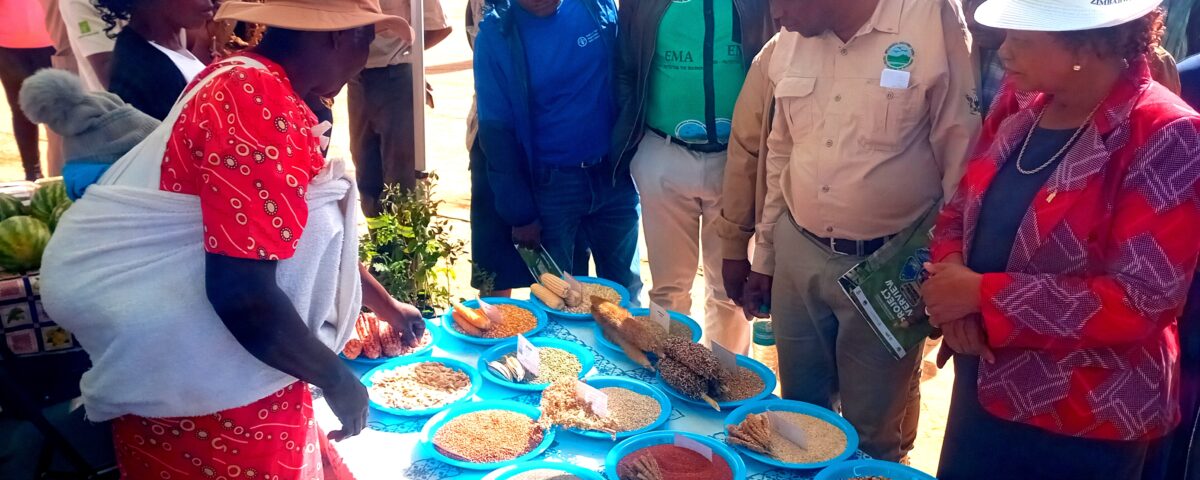
The Minister of Environment, Climate and Wildlife Evelyn Ndlovu (white hat) touring the small grains exhibition stands after officially commissioning Mutiusinazita Community Seed Bank in Buhera South last week Thursday.
“Everyone deserves a clean, safe, healthy and productive environment which sufficiently supports income generation for improved lives. By safeguarding these indigenous seeds, local communities reduce their dependence on expensive commercial seeds and they can increase their yield per hectare and recover more quickly from climate related disasters. This is therefore contributing towards the national goal of attaining a prosperous and empowered upper middle income society by 2030,” said Min Ndlovu.
Ngoni Dapira
TO hear 64 year old, Apollonia Chikwetu, from Munaro village in ward 27, Buhera South, knowledgably articulate how seed banks and climate smart agriculture works, attested a popular quote by the famous German theoretical physicist, Albert Einstein, that wisdom is not a product of schooling but of the lifelong attempt to acquire it.
Her village located roughly 170km southwest of Mutare, which is in the same ward with the popular Mutiusinazita village, has over the years been the most severely affected by land degradation and faced environmental pressures from deforestation, soil erosion and siltation of water bodies. All those factors rendered the area extremely vulnerable to accelerated impacts of climate change, until recently when mitigation measures are being implemented by government through funding from development partners. Buhera consists of eight rural wards reliant on farming, cattle ranching and irrigation, but frequently faces challenges of drought and widespread food insecurity. Which is why the area in past years predominantly relied on donor funded initiatives and non-governmental organisations (NGOs) to mitigate chronic drought and food security.
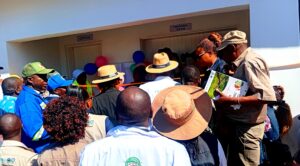
Minister Ndlovu (black jacket and hat) during the cutting of the ribbon to commission the Mutiusinazita Community Seed Bank.
However, the region has been experiencing a massive infrastructural and agricultural turnaround in recent years and last week Thursday the Minister of Environment, Climate and Wildlife Evelyn Ndlovu commissioned another agricultural turnaround initiative expected to transform livelihoods in Buhera South, the Mutiusinazita Community Seed Bank in Ward 27. The project is being funded by Global Environment Facility Seventh Cycle (GEF-7) and led by the Food and Agriculture Organisation (FAO) of the United Nations (UN). The US$104 million flagship programme is running in Zimbabwe under the GEF-7 Drylands Sustainable Landscape Impact programme (DSL-IP) that was initiated in 2021.
A seed bank is a facility that preserves plant genetic diversity by drying, freezing and storing seeds for long term conservation. The seed bank acts as a biological safety net against plant extinction, climate change and agricultural crises, ensuring that crops and native species can be regrown when needed.
It is being implemented by government institutions like the Environment Management Agency (EMA), Forestry Commission, Zimbabwe Parks and Wildlife Management Authority (Zimparks) and two NGOs, World Vision Zimbabwe and the Community Technology Development Organisation (CTDO). The project aims to mainstream sustainable land and forest management practices, combat land degradation and to strengthen ecosystem and climate resilience for improved livelihoods in the Save and Runde catchment areas.
Minister Ndlovu who hails from Matebeleland South, which is also a semi-arid region, who was appointed the Minister of Environment last year in April said as a the Environment Minister she will resolutely support climate smart agriculture initiatives because she grew up in a dryland region and knows firsthand how such a project is important in transforming rural livelihoods in semi-arid, drought prone regions that rely on growing small grains such as sorghum (mapfunde), finger millet (rukweza) and cowpeas (nyemba). She added that the impacts of climate change have been particularly severe on rural livelihoods.
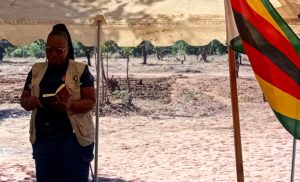
GEF-7 national project coordinator Precious Magwaza.
From four projects being implemented under the DSL-IP in Zimbabwe, Mutiusinazita became the second community seed bank to be commissioned after the Vanyoro Community Seed bank in Zaka District in Masvingo Province last year. The other two still to be commissioned are in Chipinge District and Chivi District in Masvingo. However, as a result of a tour in Chimanimani last week Wednesday by GEF-7 project stakeholders, the GEF-7 national project coordinator Precious Magwaza hinted that they may add a fifth seed bank project in Chimanimani District, but this is still under proposal stage.
The Mutiusinazita project focuses on educating communities about climate resilience and adaptation as well as teaching smallholder farmers how to grow and reintegrate wiped out traditional crop varieties that survive erratic rainfall than commercial hybrids.
“Everyone deserves a clean, safe, healthy and productive environment which sufficiently supports income generation for improved lives. By safeguarding these indigenous seeds, local communities reduce their dependence on expensive commercial seeds and they can increase their yield per hectare and recover more quickly from climate related disasters. This is therefore contributing towards the national goal of attaining a prosperous and empowered upper middle income society by 2030,” said Min Ndlovu.
She applauded the Whole-of-Government and whole-of-society approach being used in implementing the project given that the institutions and development partners are working closely with government departments such as the Ministry of Agriculture, Mechanisation and Water Resources Development, the Ministry of Women Affairs Community, Small and Medium Enterprises Development and the Ministry of Local Government and Public Works. Min Ndlovu added that the whole-of-society approach creates sustainability of the project, preventing it from collapsing after funding ceases.
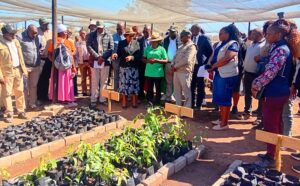
Minister Ndlovu touring the greenhouse where exotic and indigenous trees are being kept to reforest Buhera.
The Environment Minister said the GEF-7 project also advances Zimbabwe’s commitments under the United Nations Convention to Combat Desertification (UNCCD), United Nations Framework Convention on Climate Change (UNFCCC) and the Convention on Biodiversity (COB).
“Specifically, this initiative directly supports Zimbabwe’s goal to achieve Land Degradation Neutrality by 2030, as committed to under the UNCCD, while providing a scalable model for effectively tackling land and forest degradation,” said the Minister of Environment.
Min Ndlovu urged the people of Buhera to take full custodianship of the seed bank ensuring that it serves both the present and future generations. “The community seed bank concept therefore provides a practical solution serving as a critical ecological shield for Buhera through preserving indigenous and drought tolerant seeds which are essential for food ensuring food security and sustaining traditional farming systems. Through this intervention, our farmers are equipped with the necessary resources and knowledge to safeguard their crops against climate variability,” said the Minister.
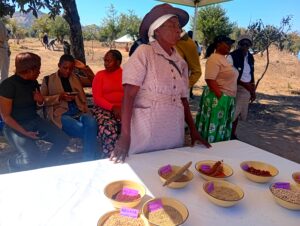
Apollonia Chikwetu at her exhibition stand
Chikwetu said the recovery of once extinct small grain crops was important as they had nutritional value that kept their forefathers healthy which explains why they lived longer for many years unlike current generations.
“Through this seed bank we have recovered three varieties of small grains that used to be grown here. There is Svoboda (barnyard millet), Rukweza rweMuswe wekitsi (finger millet) and Okashana (Rapoko). Svoboda has high nutrition and can also be value added to produce flour and brew beer, whilst Rukweza rweMuswe wekitsi is also highly nutritious,” said Chikwetu, a mother of seven children and grandmother with 24 grandchildren.
Magwaza said community seed banks play a significant role in increasing seed diversity in farmers’ hands through various activities that take place at and around the community seed banks. These activities include seed and food fairs, participatory plant breeding (PPB) by farmer field schools (FFS), germ plasm collection, seed production and marketing of climate smart crops, as well as use of appropriate modern mechanization equipment.