

Reclaiming Africa’s future: Insights from contemporary African political thought as Nkrumah’s vision comes to life 40 years down the lane through the AfCFTA
March 5, 2026
India’s relations with its partner countries are based on the principles of equality and mutual respect and not based on conditionality or prescriptions: Ambassador Kumar
March 6, 2026ITEC building bridges between Zimbabwe and India

The Minister of State for Manicaland Provincial Affairs and Devolution Honourable Advocate Misheck Mugadza (second from left) with the Ambassador of India to Zimbabwe Bramha Kumar ( third from left) at the ITEC alumni meet in Mutare last Friday.
Ngoni Dapira
THE Indian Technical and Economic Cooperation (ITEC) programme has been praised for building bridges between Zimbabwe and India, Easterntimeszim has learnt.
This was highlighted last week Friday during the inaugural ITEC alumni meet in Mutare which was officiated by the Ambassador of India to Zimbabwe Bramha Kumar. The Minister of State for Manicaland Provincial Affairs and Devolution Honourable Advocate Misheck Mugadza also presided over the event. The alumni meet drew 15 alumni from Chimanimani, Nyanga, Buhera, Mutare and surrounding areas that have participated in the ITEC programme in different professions over the years.

Minister Mugadza with Ambassador Kumar and some members of the Mutare Indian community.
The ITEC programme funded by the Indian government offers fully funded, short-term training courses in India for professionals, with applications available on the ITEC portal each year targeting government officials, private sector professionals and technical experts in various careers.
Ambassador Kumar said the ITEC programme is one of the most successful programmes as far as India’s cooperation with other countries is concerned. He said the programme was conceived by India’s first Prime Minister Pt Jawahar Lal Nehru, but was implemented by their second Prime Minister Lal Behadur Shastri in 1964.
“It is the flagship programme of the Indian Government’s technical cooperation effort with more than 150 countries (in Asia, Africa, Latin America, the Caribbean, Central and Eastern Europe, and the Pacific Island States), not only because of its wide geographical coverage, but also for innovative forms of technical cooperation and to share Indian development experience. These training programmes have contributed significantly towards capacity-building and human resource development of our friends in many parts of the world, including Zimbabwe,” said the Ambassador of India to Zimbabwe.
Ambassador Kumar added that the ITEC programme forms an important part of India’s bilateral relations with Zimbabwe since 1985. He revealed that presently, 217 slots are offered to Zimbabwe annually.
“Out of 217 ITEC slots allotted for this year, 192 seats were utilized so far, and the Public Service Commission utilised the most number of slots which stands at 20, followed by the Ministry of Agriculture and the Ministry of Home Affairs at 19 slots each,” he said.
He added that the total number of ITEC slots utilized in Manicaland region for the past four years stood at 52 and also revealed that for the 2025–26 intake four officers from Chipinge, Chimanimani and Mutare successfully attended the ITEC courses.
“These participants represent key government Ministries and Departments, including the Ministry of Primary and Secondary education (Ms. Patience Chidiriro and Mr. Anthony Muchavaka), National Archives of Zimbabwe (Mr. Oscar Sigauke) and Ministry of Environment – Meterological Services Department (Ms. Sarah Chokuangarira).”
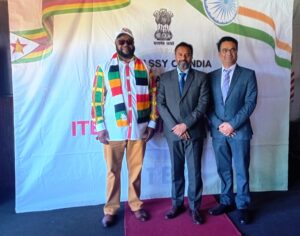
(L-R): Minister Mugadza with Ambassador Kumar and Professor Yogesh Awasthi the Dean of College Engineering and Applied Sciences at Africa University.
Minister Mugadza praised the longstanding ties between the two countries. He highlighted that capacity building was a central pillar of cooperation with India, which also, separately from the ITEC courses, offered 10 scholarships for Zimbabwe for various PhD and Post Graduate Courses this year through the Indian Council for Cultural Relations (ICCR).
He also thanked India for providing modern technical training and skilling to youths.
“It is estimated that around 5000 students are already enrolled in various Indian colleges and universities and the Government of Zimbabwe sent 71 officers to attend the Train-the- Trainer program organized by Centurion University, Bhubaneshwar,” said Minister Mugadza.
Adding, “The ITEC programme aligns with Zimbabwe’s strategic aspirations to strengthen education, scientific and technical cooperation with international partners thereby enhancing our nation’s global competitiveness which is in line with our President Dr Emmerson Mnangagwa’s vision and mission of taking this country to another level,” he said.
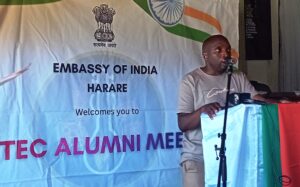
ITEC alumni Antony Muchavaka
One of the officers that attended the ITEC courses this year from 6 January to February 16, Antony Muchavaka, an English teacher from Mafumise High School in Chipinge went to the English and Foreign Language University in Hyderabad, the capital of Telangana in southern India. He said the city offers a blend of tradition and high-tech development, with major technology firms like Google and Amazon located there.
Muchavaka said he learned a lot at the premier university in India which was established in 1958 and specializes in language education, literature and linguistics.
“We learnt how to blend the traditional ways of teaching English and the modern ways. India is a country where tradition meets modernity and the richness of its culture makes it stand out, which is more or less the same like in Zimbabwe. I was also impressed by the teachers in terms of their discipline and upholding of standards,” said Muchavaka.
Another alumni who was there from February to March in 2024, Joana Mwaurayeni, said she went to the Entrepreneurship Development Institute of India (EDII) in Ahmedabad in western India, which is the largest city in the state of Gujarath.

ITEC alumni Joana Mwaurayeni
Mwaurayeni who is into agriculture value chain has her own business that is formally registered. She said she learnt a lot about how India is transforming its informal sector to formalize. She said Ahmedabad has emerged as an important economic and industrial hub in India and is the second-largest producer of cotton in India.
“I took part in the informal sector and economic development course. We learnt about India’s informal sector, business management, financial literacy, how businesses are run, value addition and we also visited other small businesses in India for practical experiences,” she said.
She added that another key insight was the importance of structured support. “I observed how training institutions, microfinance systems and targeted government programs intentionally strengthen informal entrepreneurs. Rather than viewing the informal sector as a problem to eliminate, it is seen as a sector to develop. There are deliberate efforts to provide skills training, access to finance, women-focused enterprise programs and support for value addition,” said Mwaurayeni.