

Mutare High Court quashes Clique Pharmacy director’s US$309 595 theft of trust property charges
February 2, 2026
No more to water barons says City of Mutare as it debunked its ambitious ZIG 2.5 billion 2026 approved budget
February 11, 2026US$15 mill Chinese pine tree resin factory to open end of June in Mutasa District
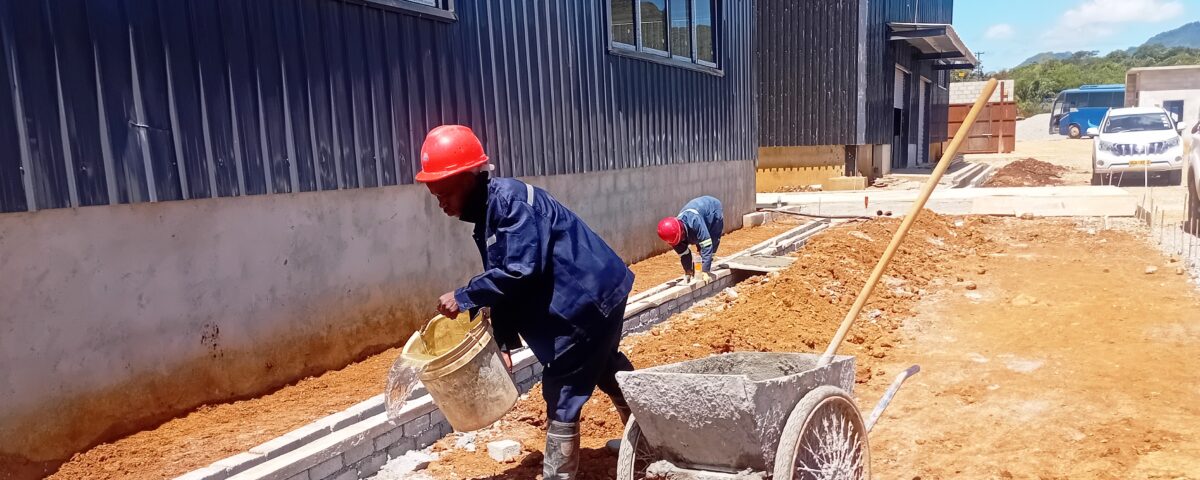
Construction workers at Komo United Resins Pvt (Ltd) in Toronto in Mutasa District going through their daily chores at the plant under construction.
…2500 jobs to be created gradually
Ngoni Dapira
A US$15 million pine tree resin plant is expected to be operational by end of June in Toronto in Mutasa District just after Christmas Pass, Easterntimeszim has learnt.

Komo United Resins Pvt (Ltd) director Shulin Zhao (standing) with his translator Austin Chihwahwa explaining the operations of the plant to the Minister of Information, Publicity and Broadcasting Services Dr Jenfan Muswere and the Minister of State for Manicaland Provincial Affairs and Devolution Advocate Misheck Mugadza (sitting left and right by the white table respectively).
This was revealed during a Mutare media tour held last week Thursday organized by the Ministry of Information, Publicity and Broadcasting Services to assess key infrastructure projects being implemented in the city under the Second Republic government. The media tour was led by the Minister of Information, Publicity and Broadcasting Services Dr Jenfan Muswere who was accompanied by the Minister of State for Manicaland Provincial Affairs and Devolution Advocate Misheck Mugadza.
The Chinese company, Komo United Resins Pvt (Ltd), is set to revive the old trade of pine tree resin production which was last done pre-independence. The Eastern Highlands is endowed with vast timber plantations and the pine tree resin plant will come as a value addition project which will not only benefit forestry companies, but also the local community in Mutasa District through job creation.
Komo United Resins Pvt (Ltd) director Shulin Zhao said when they start the plant will have the capacity to process 20 000 tonnes of resin per year, but they intend to progressively expand to produce 60 000 tonnes a year. He said at least 2500 jobs are going to be gradually created at the plant, comprising of full-time and contract workers that will work at the factory and in the plantations tapping pine tree resin.
Pine tree resin is processed into rosin (solid) and turpentine (liquid solvent), which are foundational for adhesives, sealants, paints, printing inks and rubber. Other by-products include pitch for waterproofing, pine tar for wood preservation, medicinal salves, fragrance ingredients and sustainable biodegradable composites.
Zhao said in general resin is a fluid produced by plants most commonly trees. He said the fluid can be in the form of sap which is generally a watery, sugary substance or resin which is an outgrowth that will be thicker and stickier. He said resin circulates throughout coniferous trees like the pine tree and serves to seal damage to the tree.
For pine tree resin, Zhao said they collect by first causing minor damage to the tree by drilling a hole far enough into the trunk to puncture the tree’s vacuoles. This allows sap to exit the tree, which is known as tapping, then letting the tree repair its damage by filling the wound with resin. This usually takes a few days, and then they collect the excess resin without totally damaging the tree.

The Ministers being shown inside the production plant.
Zhao however said the rosin and turpentine produced will be exported to Europe where they have a ready market. “We have the expertise to add much value to the resin in Zimbabwe. In the whole of Africa this is probably going the first project and the biggest to process resin the way we will do it. This project will also put Zimbabwe on the map in the global trade of resin because resin byproducts have a ready market in Europe,” said Zhao.
He added that the equipment and machines for the plant were shipped two months ago so they are expecting the shipment to arrive soon. However, the outlook is already showing that massive production will be done at the plant. The steel warehouses and the production plant infrastructure are already up with monomer storage tanks and distillation columns already set up.
Zhao thanked the facilitation by the office of the Minister of State for Manicaland Provincial Affairs and Devolution and the Second Republic government for allowing them to undertake this project. He also commended government on the ease of doing business in the country for foreign investors.
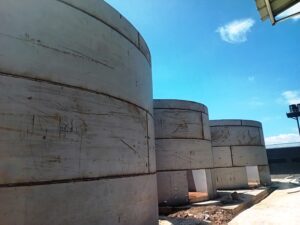
The storage tankers under construction.
Dr Muswere said the media tours being done countrywide by his Ministry are a social contract meant to improve and promote access to information by journalists.
“The media tours are a major emphasis in terms of highlighting the Second Republic’s achievements which are notable. We have a social contract that we signed in terms of supporting and resourcing members of the fourth estate through the Ministry of Information, Publicity and Broadcasting Services. The support includes transport and food as well as ensuring the freedom and access to information. This is why we are touring some of the 100 Days Cycle projects commissioned by the President Dr Emmerson Mnangagwa in Mutare last year,” said the Information, Publicity and Broadcasting Services Minister.
Minister Mugadza said Manicaland’s gross domestic product GDP is expected to grow bigger through the mushrooming value addition projects which is in tandem with the vision 2030 agenda by President Mnangagwa of turning Zimbabwe into an upper middle income economy.
“As a province God favours us indeed. We are the timber province. Before we were just making money from selling our timber from but now we will also soon create jobs and make money from pine tree resin. This is the value addition of our natural resources that our President Dr Emmerson Mnangagwa is talking about in line with vision 2030,” said the resident Minister Adv Mugadza.