


Mines Minister Dr Kambamura to officiate 2026 ZNCC Manicaland Business Awards
June 3, 2026
From SA to Zimbabwe LPS takes the lead in the motor spares and accessories sector
June 26, 2026Women in Chimanimani’s Nenhowe village take the lead in gully rehabilitation initiatives to reclaim and protect arable land
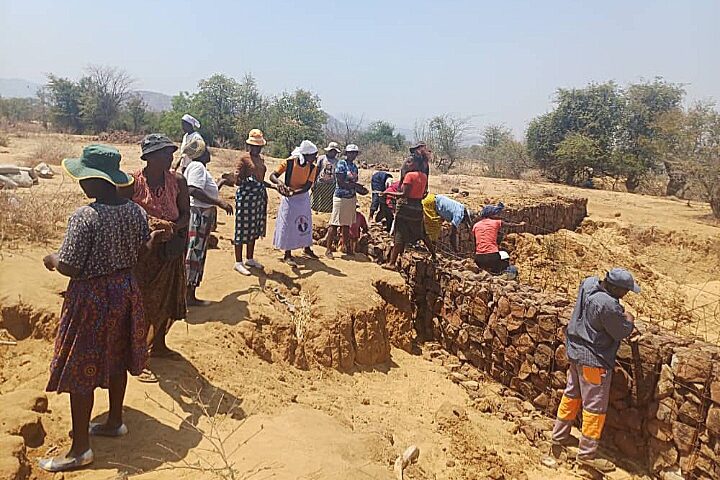
Chimanimani's Nenhowe village women took the lead in gully rehabilitation projects to reclaim and protect arable land under threat from the gullies.
Evidence Chenjerai
IN Eastern Zimbabwe, Chimanimani’s Ward 5 in Nenhowe, the Shona saying ‘Musha mukadzi’, resonated as women from the village took the lead in land rehabilitation programmes at Kuparashena where gullies are encroaching into large tracts of arable land rendering large plots unusable.
This was revealed during a media tour in Nenhowe last week Wednesday organised by the Environmental Management Agency (EMA) Manicaland region in commemoration of the 2026 World Desertification and Drought Day celebrated annually on June 17.
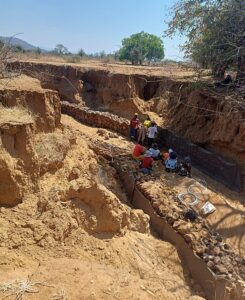
Nenhowe villagers at work in one of the gullies that was almost six metres deep.
Gullies are deep channels carved out by rushing water and they frequently form in vulnerable ecosystems such as dambos (seasonally waterlogged bottomlands) and cultivated areas with poor contour ridging.
The community led interventions implemented under the Drylands Sustainable Landscapes Project Zimbabwe are supported by the Global Environment Facility (GEF-7) through the Food and Agriculture Organisation (FAO) of the United Nations. However, what is crucial to note for sustainability of this initiative is the voluntary participation element by the community, especially women, which is being spearheaded through the community driven solutions framework to combat environmental degradation and climate variability.
365 villagers took part in the Nenhowe gully rehabilitation programme that ran for four months last year, from June to September at Kuparashena, an area which had about two hectares of arable land and a community gravesite under threat from deep gullies that were expanding each year. Part of the arable land is earmarked to be part of the Nenhowe Block C irrigation scheme expected to benefit at least 55 households when it is set up.
“We would work on the project from 7am until 4pm for four months,” said 57 years old Queen Chimwoyo, the Ward 5 village development secretary. She said from the 365 villagers that took part in the project, 80 percent were women. She said most men usually walk away the moment they hear its voluntary work without payment, but women sacrifice as caregivers naturally.
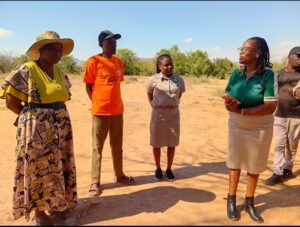
EMA Manicaland provincial education and publicity officer Alice Chivese-Rutsvara (extreme right) introducing the Nenhowe community representatives during the media tour.
Situated about 90 kilometres south of Mutare, Nenhowe village is dry land where small grains are mostly grown, but on arable land where irrigation schemes are set up, villagers grow horticultural crops throughout the year as subsistence agriculture. Desertification and gully erosion are major challenges in the area. Driven by years of deforestation, overgrazing and climate change the gullies which can be as deep as 10 metres are leading to severe loss of top soil and land degradation, threatening rural livelihoods and agricultural productivity.
As gully reclamation efforts, the villagers are taught structural controls such as construction of gabions (wire mesh filled with rocks) and how to dig contour ridges to divert water and stop head-ward gully expansion. The villagers are also doing tree planting initiatives to restore vegetative cover and protect local habitats.
Looking at the gabions, one would easily think they were done by professional builders due to the quality of workmanship, but it’s the villagers under the supervision of experts from EMA and Agritex officers from the Ministry of Agriculture, Mechanisation and Water Resources Development. The project also left villagers with knowledge, making it easy for them to implement on their own beyond the project.
Chimwoyo beamed with pride as she narrated their Kuparashena gully reclamation project, especially when she spoke about the active involvement of women. Despite their busy daily schedules with household chores, the Nenhowe women said they dedicated time towards the project. She said as women they would wake up early to make sure the children are ready for school and cook for their husbands as well, all before leaving for their shifts, whilst those that came for the afternoon shift also had to make time balancing their household chores.
“We put ourselves in groups of 30 people per three hour shift,” said Chimwoyo.
She said in June last year they started with gathering stones from nearby mountains. Once the stones were ready they were transported to the gullied area and they were supplied with mesh wire for the gabions. Environmental Management Agency(EMA)(CQLINK) provided tractors hired from locals and fuel as the rocks came from a distance in the mountains.
“We started with trenching using picks and shovels then filled the trench boxes with the stones then put the mesh wire to reinforce,” she said. Once done the community planted trees around the area as well as around the entire village. Chimwoyo said a total of 450 trees were planted.
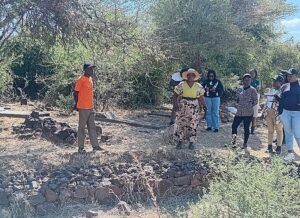
Godfrey Mutakura (orange t-shirt) and Queen Chimwoyo (wearing hat) show the graves that were about to be engulfed by one of the gullies they rehabilitated.
EMA Manicaland environmental monitoring and planning officer Chiyedza Sandi said all their interventions are now community led. She however said for the Kuparashena area they selected it as a first priority because of the gravesite that was under threat once the rain season started this year.
“At the community gravesite at Kuparashena two graves were less than two meters from being engulfed by one of the gullies. We therefore had to address the cultural restoration first but in total the Nenhowe catchment area for intervention is 300 hectares with about two hectares at Kuparashena so far rehabilitated,” said Sandi.
54 years old Godfrey Mutakura whose daughter’s grave was two meters from the gully was also part of the few male community members that took part in the project. “I watched helplessly before this intervention as the grave of my late daughter Sandra was a rain season away from being swept away, but now I am at peace. She passed away in 2002,” said Mutakura.
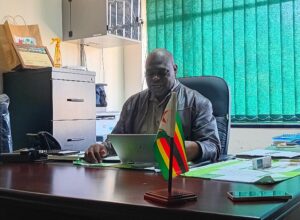
EMA Manicaland provincial environmental manager Rambwayi Mapako
Environmental Management Agency(CQLINK) (EMA) Manicaland provincial environmental manager Rambwayi Mapako said once one community has acquired some level of knowledge there should be replication within surrounding communities as they now have the capacity to become trainers of trainers.
“There should be some offshoot programs similar to be initiated by the community using their own localised resources,” said Mapako.
Mapako said whilst communities gain knowledge and expertise they are usually limited in terms of resources which is where the whole of government approach is being used to help mitigate such stumbling blocks. “This is where government and their partners mobilise resources then work with the community, giving them ownership of the project as they provide the labour,” he said.
He said the 2026 World Desertification and Drought Day commemorations global theme, “Rangelands: Recognize. Respect. Restore.” campaign highlights the critical need to protect the world’s grasslands and drylands, which support over two billion people, but currently face severe risks from escalating land degradation.
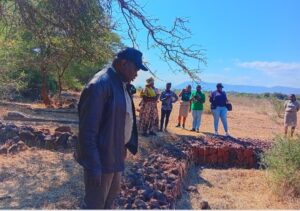
Mapako inspecting the gabions at one of the rehabilitated gullies during the media tour.
During a media briefing Mapako said this year’s Desertification and Drought Day commemorations provided an opportunity to recognize the importance of restoring degraded lands and investing in sustainable landscape management.
“This year’s theme is befittingly in resonance with the global focus, which is on rangelands and pastoral livelihoods as it is aligning perfectly with projects that Zimbabwe is implementing. Among the projects is the Drylands Sustainable Landscapes Impact Program (DSL-IP) funded by the Global Environment Facility (GEF-7) through Food and Agriculture Organisation(FAO)(CQLINK) with implementing partners including Forestry Commission , EMA, Community Technology Development Organisation, Zimparks(CQLINK) and World Vision (CQLINK),” said Mapako.
He said the Nenhowe Integrated Catchment Management(CQLINK) project in Ward 5 is a community driven solutions project on land restoration and gully reclamation that is now a flagship success story in Manicaland. “The project is restoring productive land while reducing the loss of fertile soils, promoting sustainable land management practices that improve ecosystem health, enhance water retention, and build resilience against drought and extreme weather events,” said Mapako.
Adding, “This project demonstrates how integrated land management approaches can contribute to reversal of decades of soil erosion and land degradation through rehabilitation measures such as gully stabilization, vegetation and community stewardship.”
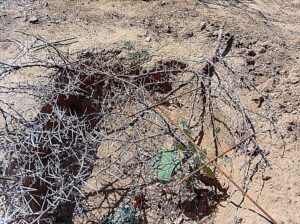
A baobab tree planted at the reclaimed gullied land.
According to UN Women (CQLINK), women constitute the majority of farms in many of the regions most severely affected by desertification, land degradation and drought. It further reveals that nearly 80 percent of employed women in the least developed countries report agriculture as their primary source of livelihood, while women comprise 43 percent of the world’s agricultural labour force.
However, the report further reveals that while women often serve as environmental stewards, they tend to be excluded from participation and leadership in conservation and management of land.
For Chimwoyo as a village development secretary, she said serving the community and saving the environment goes hand in hand.
“We are raring to go, as long as we get the resources required because this is our land, we have to take care of it so that it can take care of us,” she said.

Related posts


The permanent secretary in the Ministry of Justice, Legal and Parliamentary Affairs, Vimbai Nyemba, speaking of behalf of the Minister of Justice, Legal and Parliamentary Affairs Honourable Ziyambi Ziyambi, at the second edition of the EAC Zimbabwe National Land Conference held recently in Vumba, Mutare.